
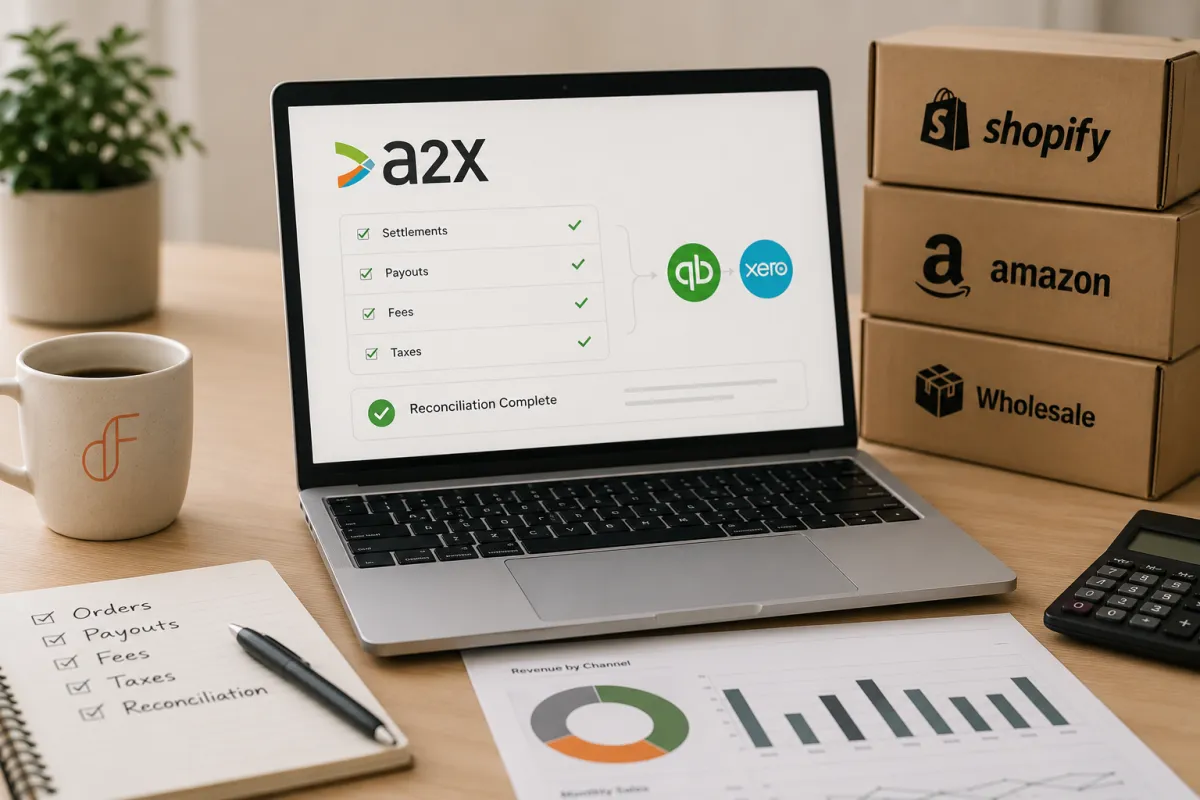
A2X for eCommerce Accounting for Growing Brands
For many eCommerce brands, accounting starts getting complicated long before revenue reaches eight figures.
You're selling on Shopify, Amazon, Walmart, wholesale portals, and maybe a few retail marketplaces. Every platform has different fees, payout schedules, refunds, discounts, taxes, and timing differences. Getting accurate financial data into QuickBooks or Xero becomes a challenge—and that's exactly the problem A2X was built to solve.
A2X has become one of the most widely used accounting automation tools in eCommerce because it solves a very real problem: reconciling sales channel activity with your accounting system. For many brands, it's an essential part of the accounting stack.
But as companies grow, founders often discover that accurate bookkeeping and actionable financial insights are not the same thing.
The challenge isn't whether your books reconcile. It's whether your financials can tell you what's actually driving profitability.
Let's look at where A2X excels, where its limitations begin to appear, and how growing brands can build on top of that foundation.
What A2X Does Well
If you've ever tried to manually reconcile Shopify or Amazon transactions in QuickBooks or Xero, you know how painful it can be.
A single payout may include:
Product sales
Shipping revenue
Refunds
Discounts
Marketplace fees
Payment processing fees
Sales tax adjustments
Trying to match those transactions manually can consume hours every month and create significant opportunities for accounting errors.
A2X automates this process by aggregating marketplace activity and posting summarized journal entries into QuickBooks or Xero. The result is cleaner bookkeeping, faster month-end closes, and more confidence that your accounting records match what actually happened on your sales channels.
For many eCommerce businesses, that's a huge win.
Accounting teams save time. Bookkeepers spend less effort on reconciliation. Founders get more reliable financial statements.
In short, A2X solves a critical operational problem.
Where the Limitations Start
The challenge appears when leadership teams begin asking deeper questions.
Questions like:
Which SKUs are actually driving profit?
Which channels are becoming less profitable over time?
How do Amazon margins compare to Shopify margins?
Which products should we reorder more aggressively?
Which products should we discontinue?
At that point, reconciliation alone isn't enough.
The reason is that A2X primarily sends summarized accounting data into QuickBooks and Xero through journal entries.
Those journal entries are excellent for accounting purposes, but they intentionally condense large amounts of transactional activity into accounting-friendly summaries.
As data gets rolled up into journal entries and line items, much of the operational detail is no longer visible inside the financial system.
You can see total revenue.
You can see total fees.
You can see total refunds.
But you often can't easily see:
Individual SKU performance
Product-level profitability
Channel-specific profitability by product
Unit economics by sales channel
Which products generated the revenue behind those totals
This isn't a flaw in A2X's design. It's simply a reflection of what the platform was built to do.
A2X was designed to make accounting accurate and efficient—not to function as a business intelligence platform.
Why SKU-Level Visibility Matters
As brands scale, profitability decisions become increasingly product-specific.
A company may appear healthy at the top-line level while individual products quietly lose money.
For example:
A brand may see strong overall revenue growth and assume performance is improving.
But a deeper SKU-level analysis might reveal:
Best-selling products have declining margins
Rising Amazon fees are eroding profitability
Certain SKUs perform well on Shopify but poorly on marketplaces
Advertising costs disproportionately impact specific products
Wholesale channels generate revenue but lower contribution margins
Without SKU-level visibility, these issues often remain hidden inside aggregate financial statements.
And when founders can't see profitability at the product level, decision-making becomes significantly harder.
Inventory planning suffers.
Marketing budgets become less precise.
Product expansion decisions rely on assumptions rather than data.
The result is that businesses can grow revenue while simultaneously reducing profitability.
The Missing Layer Between Accounting and Operations
This is where many eCommerce brands find themselves outgrowing what traditional accounting automation tools can provide.
They don't necessarily need different bookkeeping.
They need deeper visibility.
FINNESS was built to bridge that gap.
Rather than bringing data into the financial system as summarized journal entries alone, FINNESS captures and structures data at the SKU level.
That means financial reporting can answer questions that standard accounting systems typically cannot.
Instead of simply showing total sales, leaders can see:
What sold
Which channel sold it
How much revenue each SKU generated
Associated costs and margins
Product-level profitability trends over time
This creates a direct connection between accounting data and operational decision-making.
The financial statements remain accurate, but they become significantly more useful.
Channel Profitability Matters Too
For modern eCommerce brands, products are only part of the equation.
Channels matter just as much.
Many founders assume that a sale is a sale.
In reality, profitability often varies dramatically across channels.
A product that performs well on Shopify may generate very different margins on Amazon after accounting for:
Marketplace fees
Fulfillment costs
Advertising spend
Return rates
Promotional discounts
Looking only at aggregate revenue can mask these differences.
Channel-level profitability reporting helps businesses answer questions such as:
Should we invest more heavily in Shopify?
Is Amazon still our most profitable growth channel?
Which marketplaces deserve additional inventory allocation?
Where should advertising dollars be concentrated?
These decisions directly impact cash flow and long-term growth.
And they require a level of visibility that goes beyond traditional accounting reconciliation.
A2X and FINNESS Are Not Competing Solutions
One misconception we often see is that brands believe they must choose between accounting automation and deeper financial reporting.
In reality, these tools solve different problems.
A2X remains one of the best solutions available for automating reconciliation between sales channels and accounting platforms.
It helps ensure books are accurate.
It reduces manual effort.
It streamlines accounting operations.
FINNESS addresses a different challenge.
It helps founders and operators understand the underlying drivers of financial performance by connecting accounting data with SKU-level and channel-level insights.
The two approaches can complement each other.
One keeps the books clean.
The other helps leaders make better decisions.
The Bottom Line
A2X solves a genuine and important problem for eCommerce brands. For many businesses, it's a foundational part of the accounting stack and a major improvement over manual reconciliation.
But as brands grow, financial questions become more sophisticated.
Founders need to know more than whether the numbers reconcile.
They need to understand which products generate profit, which channels create value, and where growth opportunities actually exist.
That's where deeper financial visibility becomes essential.
If you're finding that your books are accurate but you're still struggling to understand what's driving profitability, you may have outgrown what A2X alone can tell you.
Let's talk about how FINNESS can help you see the full financial picture—from the SKU level up.
