
A Financial Tech Stack for CPG Brands That Scales
A wholesale purchase order can look like growth right up until it drains the cash needed to produce it. That is the practical reason a financial tech stack for CPG brands matters. When accounting, inventory, sales channels, payables, and forecasting each tell a different story, leadership is left reacting to bank balances instead of managing margin and working capital.
The goal is not to buy more software. It is to build a connected operating system that produces clean books, reliable inventory data, and decision-ready reporting. For an emerging brand, the right stack creates control without adding an internal finance department before the business is ready for one.
Start with the decisions your stack must support
Technology should follow operating needs, not the other way around. Before selecting or replacing a system, identify the questions leadership needs answered every month: Which SKUs and channels are profitable? How much cash is committed to inventory? Can the business fund the next production run? What is driving deductions, returns, freight expense, or trade spend? Which state tax obligations are accumulating?
A stack that cannot answer those questions on a dependable cadence is not complete, even if every system appears to be working independently.
For most scaling CPG brands, the core requirement is a dependable flow of information from sales and operations into the general ledger, followed by a disciplined monthly close. This creates one financial source of truth while preserving enough detail to analyze the business by SKU, channel, customer, or product line.
That detail matters. A brand can show healthy revenue growth while losing money in a particular wholesale channel because of deductions, promotional funding, freight allowances, or inefficient fulfillment. Aggregate financial statements rarely reveal that problem early enough.
The five layers of a financial tech stack for CPG brands
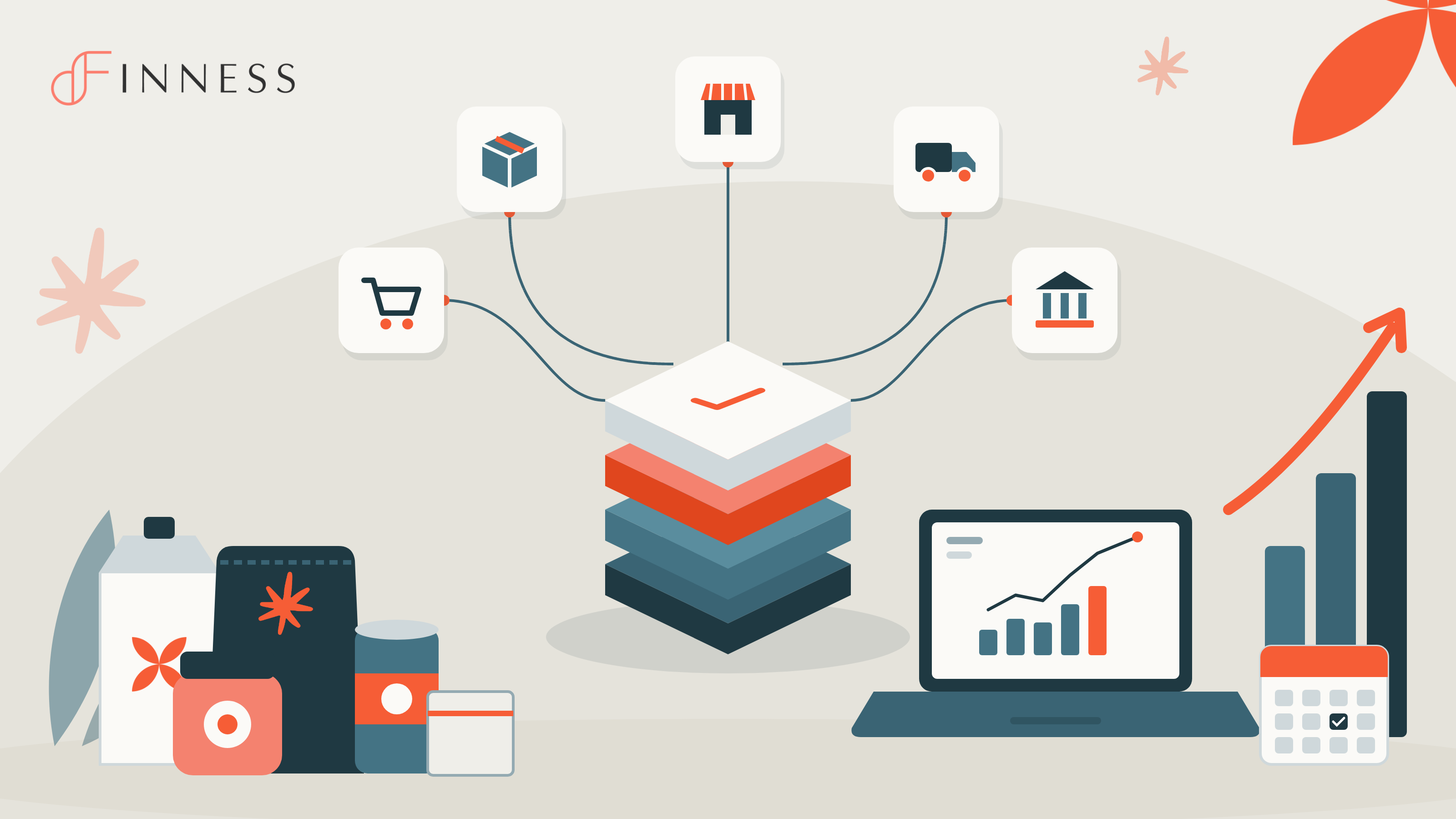
A practical CPG stack generally has five connected layers. The systems do not need to be expensive or enterprise-grade at the start. They do need clear owners, documented workflows, and a plan for how data moves between them.
1. Accounting is the financial record
The accounting platform is where operating activity becomes financial reporting. It should support a chart of accounts designed for a consumer brand, not a generic service business. Revenue, contra-revenue, cost of goods sold, freight, fulfillment, merchant fees, trade spend, and inventory-related accounts must be structured consistently from the beginning.
The most useful accounting setup also uses dimensions such as classes, locations, departments, or tracking categories. These make it possible to report by channel or business line without rebuilding the books every time management wants an answer.
The trade-off is complexity. Too many account codes and tracking fields create inconsistent coding and a slow close. Use dimensions only where the reporting will shape a decision. If the company will never act differently based on a data point, it may not belong in the accounting workflow.
2. Inventory and operations are the working-capital engine
Inventory is often the largest use of cash on a CPG balance sheet. Yet many brands rely on spreadsheets that are disconnected from accounting, purchase orders, 3PL reports, and sales forecasts. That approach becomes risky as SKU counts, warehouses, and channels expand.
An inventory management or ERP system should establish visibility into units on hand, units committed, purchase orders, production timing, landed costs, and inventory by location. It should also define how inventory movements are recorded and reconciled. If physical counts, warehouse records, and the general ledger do not agree, gross margin reporting is not dependable.
This does not always mean an immediate ERP implementation. A smaller brand with limited SKUs and straightforward fulfillment may operate effectively with a well-controlled inventory tool and disciplined reconciliations. The need for a larger system usually increases when the business adds contract manufacturers, multiple warehouses, complex bill of materials, lot tracking, or significant wholesale volume.
3. Sales and channel data explain revenue quality
E-commerce, wholesale, marketplaces, and retail portals each report sales differently. Orders, shipments, returns, fees, commissions, discounts, and deductions may appear in separate files on different timelines. Without a structured process, revenue can be recorded late, net sales can be overstated, and channel profitability becomes a guess.
The stack should capture sales data at a level that aligns with management reporting. For a direct-to-consumer business, that may include gross sales, discounts, refunds, payment processing, fulfillment, and customer acquisition costs. For wholesale, it should account for invoicing, retailer deductions, chargebacks, promotional allowances, and disputes.
Do not confuse a sales dashboard with financial reporting. A channel dashboard can show orders growing while finance reveals that cash collections are delayed or deductions are eroding the margin. Both views are useful, but they answer different questions.
4. Cash management and forecasting turn reports into action
A profit and loss statement is necessary, but it does not tell a founder whether payroll, freight, inventory deposits, and debt service can be covered six weeks from now. CPG businesses need a rolling cash forecast that incorporates actual bank activity, expected receivables, production commitments, inventory deposits, and planned operating expenses.
The best forecasting tools are only as useful as the inputs behind them. If accounts receivable aging is not current, inventory purchase orders are missing, or vendor payment dates are unknown, the forecast will create false confidence.
A practical process connects the cash forecast to a weekly operating rhythm. Leadership reviews the expected cash position, material changes to collections or spending, and decisions that need to be made before the next payment cycle. This is where finance becomes an operating tool rather than a backward-looking record.
5. Reporting and controls create confidence
The final layer is the reporting environment: financial statements, KPI dashboards, budget-to-actual analysis, and supporting schedules. A leadership team should receive reports that are timely enough to use and clear enough to challenge.
At a minimum, a scaling brand should have a monthly close calendar, account reconciliations, documented approval workflows, and a consistent reporting package. That package should connect the income statement, balance sheet, cash flow, inventory position, and key commercial metrics. Investor-grade reporting does not require a complicated presentation. It requires numbers that reconcile and explanations for what changed.
Build connections before adding more tools
Disconnected systems are not automatically a problem. Many early-stage brands operate with a small number of tools and controlled spreadsheet processes. The problem begins when data is re-entered manually, reconciliations become irregular, or reporting depends on one person knowing where every file lives.
Before purchasing another platform, map the data flow from order to cash. Identify where sales originate, where inventory changes are recorded, when invoices are issued, how payments are received, and how activity reaches the general ledger. Then identify each manual handoff and the control around it.
Automation is worthwhile when it reduces repeatable work and improves data reliability. It is less worthwhile when it automates a poorly defined process. For example, automatically importing sales data will not solve a revenue-recognition issue if the team has not determined whether revenue should be recognized at order, shipment, or delivery.
A phased approach protects cash and attention
The right stack depends on business complexity, not just revenue. A $3 million brand with a single product and one sales channel may need fewer systems than a $1 million brand selling dozens of SKUs through retail, e-commerce, and distributors.
In the foundation phase, focus on cloud accounting, clean chart-of-accounts design, bank and credit-card controls, dependable bill payment, and a monthly close process. Add a basic cash forecast and establish inventory reconciliations before the books become difficult to repair.
As sales channels and inventory complexity increase, introduce stronger inventory controls, sales-data integration, deduction management, sales-tax processes, and channel-level reporting. At this stage, the priority is preserving margin and working capital as volume grows.
At a later stage, the stack may need formal budgeting tools, more advanced planning capabilities, tighter purchasing workflows, role-based approvals, and reporting built for lenders or investors. The systems should expand because the operating model requires them, not because a larger competitor uses them.
What founders should monitor every month
A capable finance function should make a handful of operating signals visible without a scavenger hunt across platforms. Track net revenue and gross margin by meaningful channel or product group. Monitor inventory on hand, open purchase orders, inventory aging, and expected stockout risk. Review accounts receivable aging, deductions and chargebacks, and the cash forecast against planned spending.
Also compare actual results to budget or forecast. Variances are not simply accounting exercises. They reveal whether price, volume, mix, freight, labor, marketing, or production costs are moving differently than expected. That creates an opportunity to adjust before the variance becomes a cash problem.
A financial tech stack should make those conversations faster and more factual. It should not replace judgment, operational discipline, or accountability. When the systems are designed around the decisions that protect cash and margin, leaders can spend less time assembling data and more time building a business that can grow with confidence.
